
Explore Functional Vision Skills
What are "vision skills" and why do they matter?
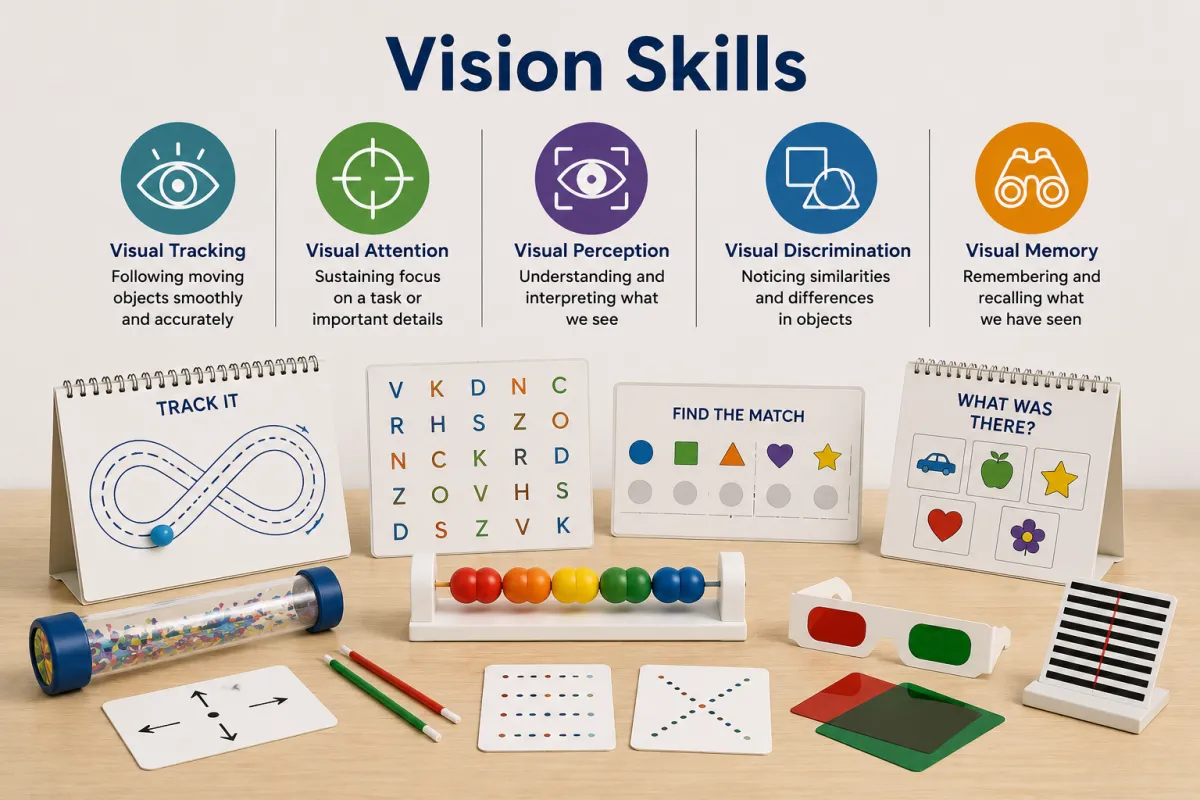
Vision is much more than seeing clearly. While visual acuity (how sharp your child's eyesight is) is important, there is a whole set of higher-level vision skills that the brain uses to make sense of what the eyes see. These skills are essential for learning, playing, and daily life. They include:
Visual perception — the brain's ability to interpret and understand what the eyes see
Visual-motor integration — the ability to coordinate what the eyes see with what the hands do (e.g., copying shapes,
writing, cutting)
Ocular motor control — the ability to move the eyes smoothly and accurately (tracking, scanning, shifting gaze)
Visual attention — the ability to focus on important visual information and filter out distractions
A child can have 20/20 eyesight and still struggle significantly with these higher-level vision skills.
What is visual perception?
Visual perception is how the brain processes and interprets visual information. It includes several distinct skills:
Visual discrimination — telling the difference between similar shapes, letters, or objects
(e.g., distinguishing "b" from "d")
Visual figure-ground — finding a specific object or shape within a busy background (e.g., finding a word on a
cluttered page)
Visual closure — recognizing a shape or object when part of it is missing or hidden
Visual spatial relationships — understanding how objects are positioned in space relative to each other and to oneself (e.g., understanding left/right, up/down, spacing between words)
Visual sequential memory — remembering a sequence of shapes, letters, or numbers in the correct order
Visual form constancy — recognizing a shape or letter even when it changes size, color, or orientation
These skills work together to support reading, writing, math, and everyday tasks like finding items in a drawer or navigating a crowded hallway.
How do vision skills affect school performance?
Research consistently shows that visual perception and visual-motor integration are significantly associated with academic achievement. Studies have found:
Better visual perception uniquely predicts better reading and math skills, even after accounting for IQ and attention
Better motor coordination is associated with better reading, writing, and math skills
Visual-motor integration (the combination of visual perception and motor coordination) is uniquely associated with
math performance
Visual spatial relationships show particularly strong correlations with academic achievement across subjects
Performance on oculomotor tests (such as the Developmental Eye Movement test) is one of the strongest visual
predictors of academic performance in reading, writing, spelling, grammar, and numeracy
Children who struggle with vision skills may be misidentified as having attention problems, learning disabilities, or behavioral issues when the underlying difficulty is actually visual.
What are signs that my child may have vision skill difficulties?
Watch for these signs, which may indicate problems with visual perception, visual-motor integration, or ocular motor control:
Difficulty learning to read or slow reading progress
Reversing letters or numbers (beyond the typical age)
Trouble copying from the board or from a book
Messy or poorly spaced handwriting
Difficulty with puzzles, building with blocks, or other spatial tasks
Trouble finding objects in a cluttered space (e.g., finding a toy in a toy box, a word on a page)
Difficulty cutting on a line or coloring within boundaries
Avoiding drawing, writing, or other visually demanding activities
Complaints of headaches, eye strain, or fatigue during close work
Losing place while reading or skipping lines
Difficulty with math concepts that involve spatial reasoning (geometry, number alignment, graphs)
Clumsiness or difficulty judging distances
How does an occupational therapist evaluate vision skills?
An occupational therapist trained in visual assessment can evaluate the full range of vision skills that affect daily function. A comprehensive evaluation may include:
Beery-Buktenica Developmental Test of Visual-Motor Integration (Beery VMI) — the most widely used assessment in pediatric OT (used by 85% of pediatric OTs), measuring how well the child coordinates vision and hand movement by copying geometric forms. It includes supplemental tests of visual perception and motor coordination
Test of Visual Perceptual Skills (TVPS) — a motor-free test that measures visual discrimination, visual spatial relationships, visual sequential memory, visual figure-ground, and visual closure
Motor-Free Visual Perception Test (MVPT) — another motor-free assessment of visual perception that does not require hand use, making it useful for children with motor difficulties
Developmental Eye Movement (DEM) test — assesses oculomotor behavior during a reading-like task
Structured Observation of Sensory-motor Integration (SOSI-M) -- watches how your child's body and senses work together — like balance, movement, and coordination
Clinical observation of how the child performs functional tasks — reading, writing, copying, cutting, puzzles, and play
Sensory Profile — to understand how the child processes visual and other sensory information
Parent and teacher interviews about functional concerns at home and school
If significant concerns are identified, the OT may recommend a referral to a developmental optometrist or pediatric ophthalmologist for a comprehensive eye examination.
How does occupational therapy improve vision skills?
Occupational therapy addresses vision skills by connecting visual abilities to real-life function — not just practicing visual exercises in isolation. Treatment may include:
Visual-motor integration activities — tasks that require the eyes and hands to work together, such as copying shapes, mazes, bead stringing, origami, and building with blocks. Research shows that combining origami and copying activities has the strongest association with visual-motor integration development
Visual perceptual training — structured activities targeting specific perceptual skills (discrimination, figure-ground, spatial relationships, closure). An RCT showed that multimedia visual perceptual group training produced significant improvements in preschool children with developmental delays
Handwriting intervention — because handwriting depends heavily on visual-motor integration and visual perception, OTs address the visual foundations alongside motor practice. Research shows that visual-perceptual training significantly improves far-point copy speed and handwriting accuracy
Ocular motor training — exercises to improve eye tracking, saccades (eye jumps), and convergence, often integrated with vestibular (movement) activities because the balance system is directly connected to eye movement control
Sensory integration therapy — using purposeful, play-based activities to help the brain better organize sensory information, including visual input. Strong evidence supports Ayres Sensory Integration for improving goal attainment and occupational performance
Environmental modifications — recommendations for lighting, contrast, reducing visual clutter, seating position, and use of visual supports at home and school
Compensatory strategies — teaching the child techniques to manage visual challenges (using a reading guide, color-coding, organizational systems)
What is visual-motor integration and why is it so important?
Visual-motor integration (VMI) is the ability to coordinate visual information with hand and body movements. It is one of the most critical skills for school success. VMI is required for:
Handwriting — forming letters, spacing words, staying on the line
Copying — reproducing shapes, letters, numbers, and diagrams from a model
Cutting — guiding scissors along a line
Drawing and coloring — creating shapes and staying within boundaries
Math — aligning numbers, drawing graphs, understanding geometry
Sports and play — catching a ball, building with blocks, completing puzzles
Research shows that preschool children with developmental delays who receive occupational therapy demonstrate statistically significant improvement in visual-motor skills and develop these skills at a rate faster than expected compared to typically developing peers.
Is OT for vision skills the same as vision therapy from an eye doctor?
Our licensed and experienced therapists adhere to the highest standards of care. We regularly update our practices based on the latest research and guidelines in occupational therapy. Additionally, we follow strict hygiene and safety protocols to protect our clients and staff.
Get In Touch

Serving Meadville and Surrounding Areas
MEDICAL DISCLAIMER:
All information on this website is intended for instruction and informational purposes only. The authors are not responsible for any harm or injury that may result. Significant injury risk is possible if you do not follow due diligence and seek suitable professional advice about your injury.
No guarantees of specific results are expressly made or implied on this website.
Copyright © 2026 All Rights Reserved by Bridging Roots Therapy.