
Explore Ocular Motor Skills
What are ocular motor skills?
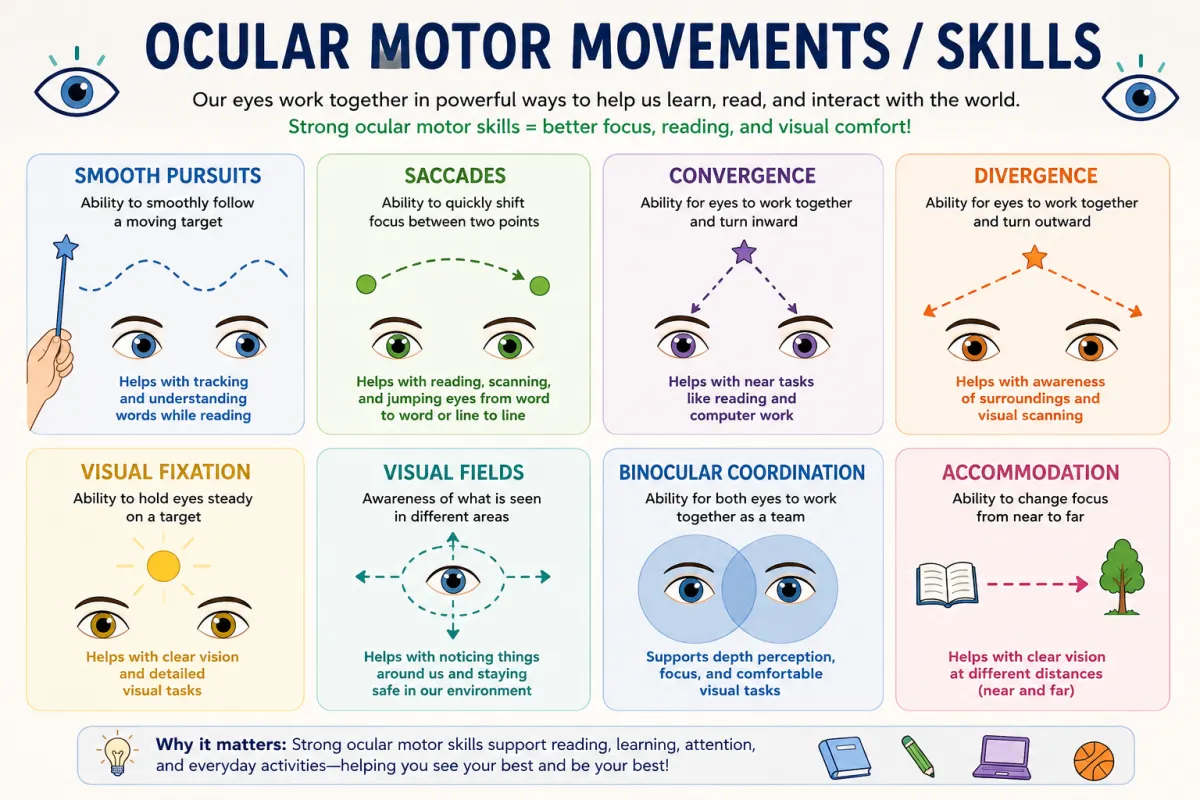
Ocular motor skills are the eye movement abilities that allow us to control where and how our eyes move. These skills are essential for reading, writing, catching a ball, navigating the environment, and nearly every task that requires vision. The main ocular motor skills include:
Visual fixation — the ability to hold the eyes steady on a single target (e.g., looking at a word on the page)
Smooth pursuit (visual tracking) — the ability to smoothly follow a moving object with the eyes (e.g., watching a ball roll across the floor)
Saccades — the ability to quickly and accurately shift the eyes from one target to another (e.g., moving the eyes from word to word while reading, or looking from the board to the paper when copying)
Convergence — the ability to turn both eyes inward to focus on a close object (e.g., looking at a book held at reading distance)
Divergence — the ability to turn both eyes outward to focus on a distant object (e.g., looking up at the board after reading)
Why are ocular motor skills important for children?
Ocular motor skills are the foundation for many everyday activities, especially at school. Children rely on these skills to:
Read fluently — moving the eyes smoothly across a line of text and accurately jumping to the next line
Copy from the board — quickly shifting focus between a distant target and a near surface
Write legibly — keeping the eyes on the paper and guiding the hand
Catch, throw, and kick a ball — tracking a moving object in space
Navigate the environment — scanning for obstacles, finding objects, and moving safely
Complete puzzles, crafts, and other fine motor activities
When ocular motor skills are weak, children may struggle with these tasks even though their eyesight (visual acuity) is perfectly normal.
What are signs that my child may have ocular motor difficulties?
Signs of ocular motor problems can look very different from typical "vision problems." Your child may have passed a standard eye chart test but still have difficulty with eye movement control. Watch for:
Losing place frequently while reading or skipping lines
Using a finger to keep place while reading
Slow or labored reading
Difficulty copying from the board — frequently looking up and losing place
Reversing letters or numbers
Complaints of words "moving" or "jumping" on the page
Headaches, eye strain, or fatigue during reading or close work
Closing or covering one eye during reading
Tilting or turning the head to one side
Poor hand-eye coordination — difficulty catching a ball, cutting on a line, or threading beads
Short attention span for reading or near-work tasks
Avoidance of reading, writing, or other visually demanding activities
Are ocular motor problems the same as needing glasses?
No. Ocular motor problems are different from needing glasses. Glasses correct how clearly the eyes see (visual acuity or focus), while ocular motor problems involve how well the eyes move and work together. A child can have 20/20 vision on an eye chart and still have significant difficulty with eye tracking, eye teaming, or focusing. This is why a standard vision screening at school or the pediatrician's office may not detect ocular motor problems. A more comprehensive evaluation is needed.
How does an occupational therapist evaluate ocular motor skills?
An occupational therapist trained in visual assessment can evaluate ocular motor skills as part of a comprehensive evaluation. This may include:
Clinical observation of eye movements — watching how the child's eyes track a moving target (smooth pursuit), shift between two targets (saccades), and converge on a near object
Standardized screening tools such as the Developmental Eye Movement (DEM) test, which assesses oculomotor behavior during a reading-like task
Assessment of visual-motor integration using the Beery VMI — evaluating how well the child coordinates what the eyes see with what the hands do
Observation of functional performance — how the child reads, copies, writes, cuts, and catches
Screening for convergence insufficiency — measuring the near point of convergence (how close an object can come to the nose before the child sees double)
Assessment of how ocular motor difficulties affect daily activities, school performance, and participation
If the OT identifies significant ocular motor concerns, a referral to a developmental optometrist or pediatric ophthalmologist may be recommended for a comprehensive eye examination.
How does occupational therapy help with ocular motor skills?
An occupational therapist can address ocular motor skills as part of a broader treatment plan that connects eye movement control to functional performance. OT for ocular motor difficulties may include:
Eye tracking exercises — practicing smooth pursuit by following a moving target with the eyes (e.g., a ball on a string, a flashlight on the wall, or a moving finger)
Saccade training — practicing quick, accurate eye jumps between targets (e.g., finding letters on a chart, shifting gaze between two objects)
Convergence activities — exercises to strengthen the ability to focus both eyes together at near distances
Visual-motor integration activities — tasks that require the eyes and hands to work together (e.g., copying shapes, mazes, bead stringing, building with blocks)
Sensory integration therapy — using vestibular (movement) and proprioceptive (body awareness) input to support the development of eye movement control, since the vestibular system is closely connected to the ocular motor system
Functional task practice — applying improved eye movement skills to real-life activities like reading, writing, copying, and ball skills
Get In Touch

Serving Meadville and Surrounding Areas
MEDICAL DISCLAIMER:
All information on this website is intended for instruction and informational purposes only. The authors are not responsible for any harm or injury that may result. Significant injury risk is possible if you do not follow due diligence and seek suitable professional advice about your injury.
No guarantees of specific results are expressly made or implied on this website.
Copyright © 2026 All Rights Reserved by Bridging Roots Therapy.