
Explore Sensory Processing and
Sensory Regulation
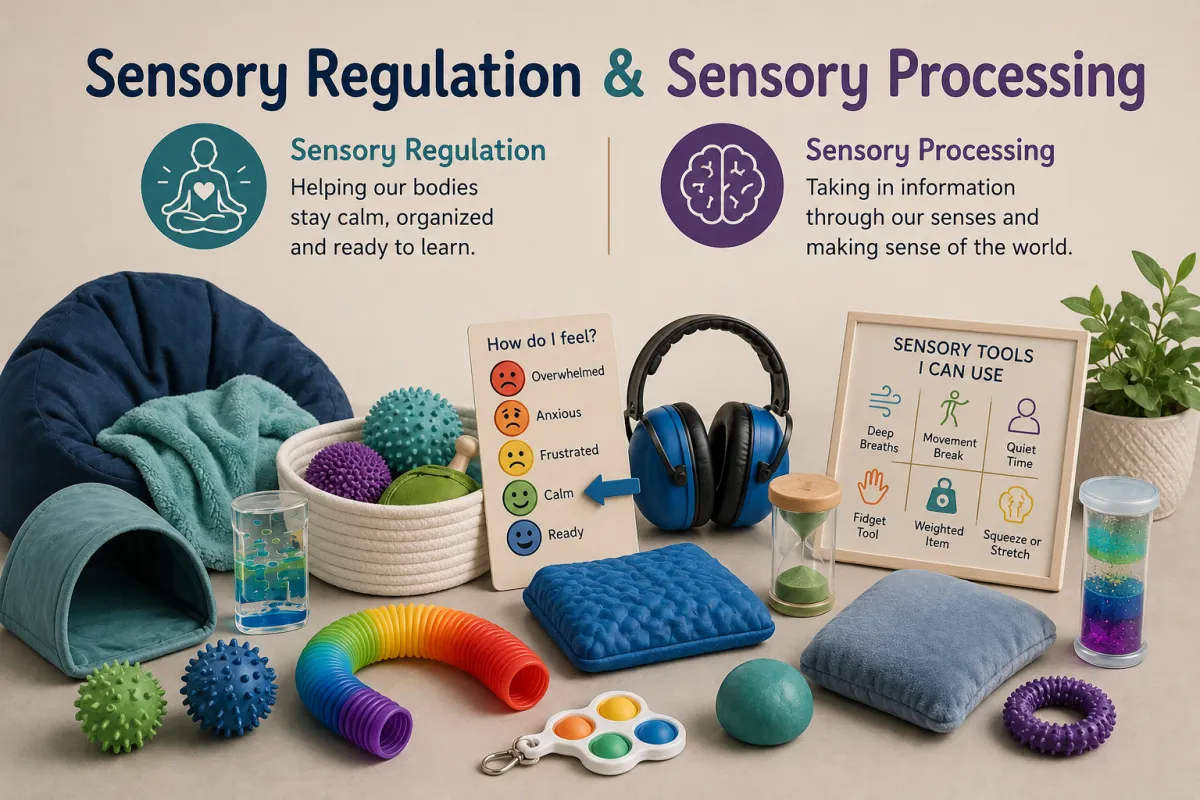
What is sensory processing?
Sensory processing is the way the brain receives, organizes, and responds to information from the senses. Most people think of the five basic senses — sight, hearing, touch, taste, and smell — but there are actually additional sensory systems that are critical for everyday function:
Tactile (touch) — awareness of light touch, pressure, temperature, pain, and texture
Auditory (hearing) — processing sounds, distinguishing speech from background noise
Visual (sight) — interpreting what the eyes see, including brightness, color, and movement
Gustatory (taste) and olfactory (smell) — processing flavors and scents
Vestibular (balance and movement) — detecting head position and movement; essential for balance, coordination, and knowing whether the body is moving or still
Proprioceptive (body awareness) — sensing where the body is in space through input from muscles and joints; essential for grading force, motor planning, and body coordination
Interoceptive (internal body signals) — sensing internal states such as hunger, thirst, needing the bathroom, heart rate, and temperature
When sensory processing works well, the brain automatically filters, organizes, and responds to sensory information in a way that allows the child to pay attention, learn, play, and manage daily routines. When sensory processing is inefficient, everyday experiences can become overwhelming, confusing, or under-stimulating — leading to difficulties with behavior, attention, learning, and participation.
What is sensory regulation?
Sensory regulation (also called self-regulation) is the ability to manage one's level of alertness and emotional state in response to sensory input so that behavior and attention are appropriate for the situation. A well-regulated child can:
Stay calm and focused during a classroom lesson
Transition smoothly between activities
Tolerate unexpected sensory experiences (a fire alarm, a scratchy shirt tag) without becoming overwhelmed
Adjust their energy level — calming down for bedtime or revving up for recess
Children with sensory regulation difficulties may have trouble maintaining an appropriate level of alertness. They may swing between being "too high" (overexcited, hyperactive, anxious) and "too low" (sluggish, inattentive, withdrawn), or they may get stuck in one state and have difficulty shifting.
What are the different types of sensory processing difficulties?
Research has identified several patterns of sensory processing differences. A child may show one or more of these patterns:
Sensory over-responsivity (hypersensitivity) — the brain reacts too strongly to sensory input. The child may become distressed, anxious, or aggressive in response to ordinary sensations such as certain sounds, textures, lights, or being touched. This is the most common pattern identified in children with sensory processing difficulties. Research shows that sensory over-responsivity is associated with elevated anxiety.
Sensory under-responsivity (hyposensitivity) — the brain does not register sensory input efficiently. The child may seem unaware of pain, temperature changes, or being called by name. They may appear passive, slow to respond, or "in their own world." Research links this pattern to higher ADHD-related behaviors.
Sensory seeking/craving — the child actively seeks out unusually large amounts of sensory input, such as constant movement, jumping, crashing, mouthing objects, touching everything, or making loud noises. This pattern is also associated with higher ADHD-related behaviors.
Sensory-based motor disorder — difficulty with balance, coordination, and motor planning due to poor processing of vestibular and proprioceptive information
Sensory discrimination disorder — difficulty telling the difference between similar sensory inputs (e.g., distinguishing shapes by touch, telling similar sounds apart)
Many children show a combination of these patterns, and over half of children identified with sensory processing difficulties display more than one type.
How does occupational therapy help with sensory processing and regulation?
An OT is a specially trained person who works with children to make daily life easier. Here's how they help with sensory processing:
Finding out what's tricky. The OT starts by learning what kinds of sensory things are hard for you. Maybe certain textures bother you, or maybe you need to move around a lot to feel comfortable.
Fun activities with a purpose. The OT uses activities like swinging, climbing, playing with different textures, or using special tools like weighted blankets or therapy balls. These activities help your brain get better at handling sensory information.
Learning to self-regulate. "Self-regulation" means being able to keep your body and feelings in a calm, "just right" zone. The OT teaches you strategies — like deep breathing, squeezing a stress ball, or taking movement breaks — so you can manage how you feel when things get overwhelming.
Creating a "sensory diet." This isn't about food! A sensory diet is a personalized plan of sensory activities built into your daily routine. It might include things like jumping on a trampoline before homework or listening to calming music during transitions. These activities help keep your brain balanced throughout the day.
Helping at home and school. The OT also works with your parents and teachers to make changes in your environment — like using noise-canceling headphones in a loud classroom or adjusting lighting — so you can focus and participate more easily.
Over time, occupational therapy can help your child feel more comfortable, do better in school, and enjoy everyday activities with less stress!
Get In Touch

Serving Meadville and Surrounding Areas

MEDICAL DISCLAIMER:
All information on this website is intended for instruction and informational purposes only. The authors are not responsible for any harm or injury that may result. Significant injury risk is possible if you do not follow due diligence and seek suitable professional advice about your injury.
No guarantees of specific results are expressly made or implied on this website.
Copyright © 2026 All Rights Reserved by Bridging Roots Therapy.